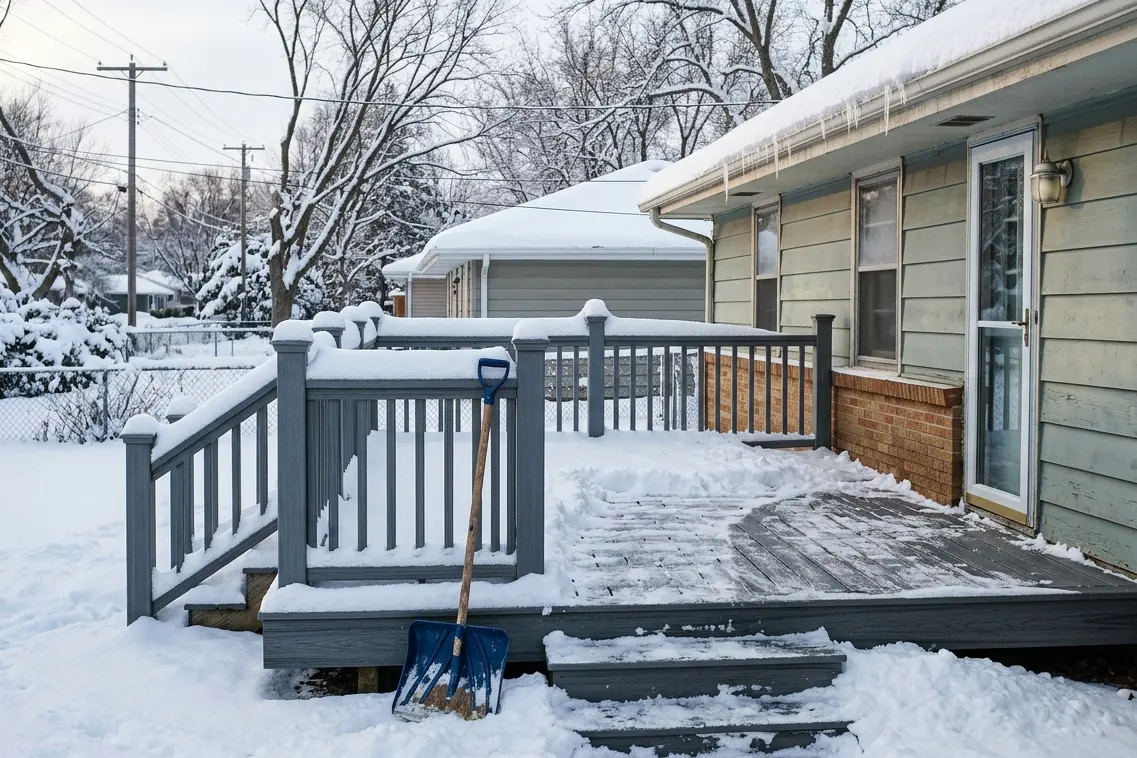
Do you need to shovel your deck at all?
A deck built to Minnesota code is framed for heavy snow loads, so ordinary snowfall sitting on the boards is usually fine. Plenty of homeowners leave most of the deck alone and keep a path open to the door, the grill and the stairs. The bigger reasons to clear it are access and water. Deep snow piled against the house wall melts during the March thaw and feeds water toward the ledger, the siding and the patio door threshold.
There are also times when clearing matters more. Wet spring snow weighs far more than fluffy January powder, and repeated storms with a thaw in between can pack into dense layers capped with ice. Older decks with undersized framing, rotted joists or a nailed ledger have less margin than a new build. If your deck is a couple of decades old and has never been inspected, keep the snow load light and have someone look at the frame before next winter.
Shovel along the boards with a plastic blade
Your shovel matters more than your technique. A plastic blade, or a shovel with a rubber or plastic wear strip, is the safest tool for both wood and composite. Steel edges catch board ends, gouge soft cedar and scratch the protective cap on composite and PVC. Push the shovel in the same direction the boards run, not across them, so the blade glides along the length of each board instead of catching every seam, gap and fastener head on the way.
Leave the last half inch or so of snow on the deck instead of scraping down to bare boards. The sun will usually finish the job, and you avoid grinding grit into the surface. Toss snow off the side away from shrubs, window wells and the air conditioner, and never pile it on the stairs or against the railing. A snowblower is risky on a deck because the auger and scraper bar can catch boards, so check the board maker's care sheet before you try one.
- Plastic or rubber-edged shovel blade only
- Push along the length of the boards, never across them
- Stop a little short of bare boards and let the sun finish
- Never chip ice with a shovel edge, ice chopper or hammer
Choosing an ice melt that will not harm your deck
Rock salt is what most people keep in the garage, but it pits some deck boards, leaves white residue, and its brine soaks into wood and attacks fasteners. Calcium magnesium acetate is kinder to most surfaces. Guidance on other products, including calcium chloride, varies from one board maker to the next, so the care sheet for your specific board line is the only reliable answer. If you do not know which boards you have, a photo of an end cut often helps us identify them.
Use ice melt sparingly and only where people actually walk. Spread a light layer, let it work, then push the slush off with your plastic shovel instead of letting it refreeze into a sheet. In spring, rinse the deck with a garden hose to wash residue off the boards and out of the gaps. Sand gives grip on wood stairs but can scratch some composite surfaces, so check before using it, and sweep it off once the ice is gone.
When roof snow sliding onto a deck becomes a load problem
The real danger is snow coming off the house, not snow falling from the sky. A steep metal roof or a long shingled slope above a deck can drop a slab of packed snow and ice onto one section in seconds. That pile can be several times deeper than the snow around it, much denser, and concentrated on a small area of framing. Decks under valleys and eaves on tall two-story homes in the outer suburbs see this more than most.
If you notice any of the signs below, keep everyone off the deck until it has been checked. Clear the pile from the outside edge working inward, so you are not standing in the middle of the heaviest load, and never stand under an eave with snow still hanging over it. Raking the lower edge of the roof from the ground before the next storm cuts down on future slides. For a lasting fix, a small deck roof or a stronger frame under the drop zone can help.
- A deck that bounces or flexes where it used to feel solid
- Boards sagging visibly between joists under the pile
- A patio door that sticks or rubs after a slide
- Popping or cracking sounds while the snow is sitting there
Clearing deck stairs so nobody slips
Stairs are where a winter deck turns dangerous, because the treads are narrow and a slip there means a longer fall. Clear them every time it snows, working from the top down, so you always have a clean step below you. Push snow off the open side of each tread rather than onto the next step. Keep the landing at the bottom clear too, since that is where meltwater from the stairs collects and freezes overnight into a hard, glassy patch.
Ice on stairs often traces back to a leaking gutter, a downspout dumping onto the landing, or a roof edge dripping on the top step. Fixing that water source does more than any bag of ice melt. Open-riser stairs shed snow better than closed ones, handrails you can grip in gloves matter in January, and stair lighting helps on short winter afternoons. Cupped, loose or split treads hold water and ice longer, which is a good reason to rebuild them. Call (612) 979-0602 any hour.
What to check on your deck once the snow is gone
After the last melt, take a slow walk around the deck in daylight. Winter shows its effects in April, when the boards dry out and the frame settles. Look for boards that lifted, fasteners that popped up, railings that wobble, and stairs that shifted at the landing. Check the area where roof snow landed for any sag. Gouges or pitting from shovels and salt tell you what to change in your routine next winter.
- Popped screws or nails standing above the board surface
- Railing posts that rock when you push on them
- Gaps at the ledger or stair stringers that were not there in fall
- Low spots where water now ponds on the boards
Common questions
Is it safe to use a leaf blower to clear snow off a deck?
For light, dry snow, yes. A leaf blower moves fluffy powder off the boards and out of the gaps without touching the surface at all, which makes it one of the gentlest options. It will not move wet, heavy snow or ice, though, so keep a plastic shovel handy for anything deeper than an inch or two.
Can shoveling affect my composite deck warranty?
Shoveling with a plastic shovel fits what most makers recommend. The details vary, though, and the care sheet for your board line is what counts. Composite makers back their boards with long limited warranties, and their care guidance sits alongside them. If you are not sure which board you have, we can identify it and tell you which warranty applies.
Should I knock down icicles hanging over my deck?
Large icicles over a deck or stairs are worth removing carefully, because a falling one can crack a board or hurt someone. Knock them down from a safe distance with a long pole, never from directly below. Icicles that return year after year also point to an ice dam or attic ventilation issue, which is a roof problem rather than a deck one.