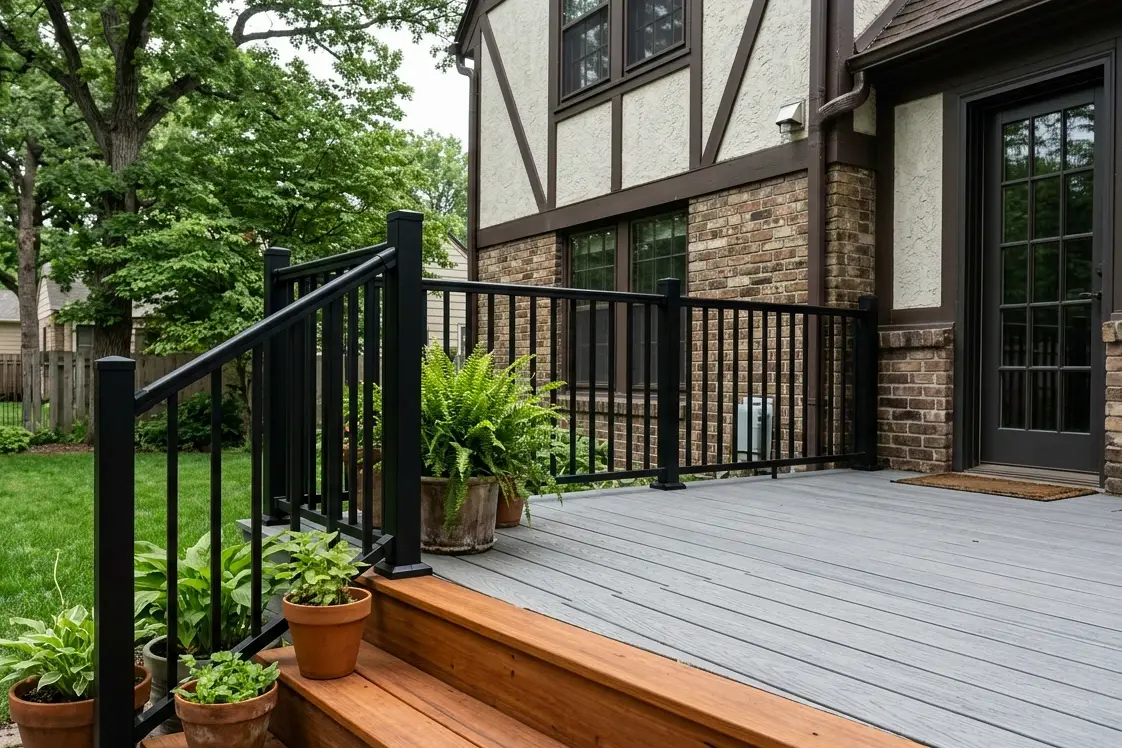
What each decking material typically costs installed
Installed price covers far more than boards. It includes footings, framing, fasteners, basic stairs and labor, which is why the ranges overlap. Pressure-treated decks typically run $36 to $61 per square foot installed. Cedar decks typically run $46 to $78 per square foot installed. Composite decks typically run $58 to $97 per square foot installed, and PVC decks typically run $67 to $112 per square foot installed. A 16 by 20 foot deck is 320 square feet, so a few dollars per foot adds up quickly.
These ranges are typical and depend on height, access, railing choice, stair runs and how much old deck we tear off first. A tall walkout deck in Maple Grove costs more per foot than a low back deck off a Richfield rambler, even in the same material. Treat the numbers as a way to compare materials, not as a quote. The real figure comes after we look at your yard, your house and the deck you want to stand on.
Pressure-treated and cedar: real wood with real upkeep
Pressure-treated pine is the workhorse framing lumber under almost every deck, and plenty of homeowners use it for the walking surface too. It is strong, takes stain well and costs the least up front. It also checks, cups and splinters as it dries over the first few years, and hot Minnesota sun followed by freezing nights speeds that along. Plan on regular cleaning and a fresh coat of stain every few years if you want it to stay smooth and even in color.
Cedar is lighter, more stable and smells great when it's fresh off the saw. Its natural oils resist rot better than untreated pine, and it weathers to a soft silver gray if you leave it alone. Most people choose cedar for its warm color, though, which means a penetrating oil stain such as Cabot or Ready Seal on a regular cycle. Cedar is also softer than treated pine, so chair legs, dog claws and a steel shovel edge leave marks you will notice.
Composite and PVC: less upkeep, different trade-offs
Composite boards from makers like Trex, TimberTech, Fiberon and Deckorators blend plastic and wood fiber under a hard protective shell. PVC boards, such as AZEK, skip the wood fiber entirely. Neither needs staining, neither splinters, and both shrug off the moisture that slowly rots wood. Composite makers back their boards with long limited warranties; we will tell you which one applies to the board line you pick and what the care guidance asks of you.
The trade-offs are heat, movement and price. Dark composite and PVC boards get hot in full July sun, so lighter colors make sense on a south-facing deck without shade. Both expand and contract with temperature more than wood does, so gapping and fastening have to follow the maker's install guide closely, especially when we build in cold weather. PVC weighs less and handles moisture best, which is why we often reach for it on low decks close to the ground and on rooftop decks over living space.
How each material handles snow, ice and a Minnesota thaw
Snow sitting on the boards does not hurt any of these materials. The damage comes from how it gets removed and from water that lingers during the thaw. Steel shovel edges gouge cedar and scar composite caps. Rock salt pits some boards and stains others, while calcium magnesium acetate is kinder to most surfaces. The board maker's care sheet is the final word before you spread anything, since the guidance varies from brand to brand and even between product lines from one maker.
Wood soaks up water during the long March and April thaw, freezes again overnight, and slowly opens checks and cracks along the grain. A good sealer slows that cycle down. Composite and PVC do not absorb water the same way, so freeze-thaw swings mostly leave the surface alone, but the framing underneath is still wood. Whatever surface you choose, we flash the ledger, gap the boards so meltwater drains, and use hot-dip galvanized or stainless hardware rated for treated lumber.
Picking the material that suits your house and yard
Tall second-story decks on 1980s to 2000s walkout homes in Plymouth, Eden Prairie or Woodbury catch a lot of sun and are awkward to reach for refinishing. Composite or PVC often pays off there, because staining a deck twelve feet in the air is slow, clumsy work. A low back deck on a 1920s Longfellow bungalow is far easier to maintain, and cedar suits the age of the house. Shade, tree cover, pets and how often you host all steer the choice too.
Railings and stairs deserve the same thought. A composite deck paired with a treated wood railing saves money now but leaves you staining the rail while the floor needs only washing. Composite or aluminum railing systems from Westbury, Fortress or Key-Link cost more, yet they keep the whole deck on the same low-upkeep schedule. Stair treads take the hardest wear of any boards, so they are often where a harder capped board earns its price first.
- Full south sun: lighter board colors stay cooler under bare feet
- Big dogs: capped composite or PVC hides claw marks better than cedar
- Heavy shade: any surface needs washing, and wood needs restaining sooner
- Tight budget now: a treated frame spaced to take composite boards later
Thinking about cost over 20 years, not just install day
Over two decades, a wood deck collects a steady string of upkeep costs: cleaning, staining, swapping out a few cupped or cracked boards, and resetting fasteners that work loose. If you hire that work out, the visits add up. If you do it yourself, the cost is your weekends. Composite and PVC cost more on day one but ask for little beyond an occasional wash, so the gap between them and wood narrows the longer you own the deck.
How long you plan to stay matters as much as the material. If you expect to sell within five years, a well-kept pressure-treated or cedar deck may be the sensible pick. If this is the house you plan to retire in, a composite or PVC surface over a properly built treated frame often makes more sense. Many homeowners split the difference with composite boards and a wood or aluminum railing. Call (612) 979-0602 and we will walk through the options for your yard.
Common questions
Is composite decking slippery in a Minnesota winter?
Any deck surface gets slick under ice or packed snow, and composite is no exception. Boards with a deeper embossed grain give a little more grip than smooth ones. Clearing snow before it packs down, and using a traction product the board maker approves, does more for your footing than the material itself. Give the stairs extra attention, since a slip there is a longer fall.
Can composite boards go on top of my existing wood deck frame?
Sometimes. Composite usually needs joists spaced closer together than the old wood boards did, especially for diagonal patterns, and the frame has to be sound with a flashed ledger. We check joist spacing, rot, hangers and footings first. If the frame passes, resurfacing with composite saves the cost of a full rebuild and gives you a new surface on a proven structure.
Does a cedar deck need stain, or can I let it go gray?
You can let it weather. Cedar's oils resist rot on their own, and the gray patina only sits on the surface. Unstained cedar does dry out and check more in our sun and freeze cycles, though, and it collects mildew in shady corners. A penetrating oil every few years keeps the wood more stable and holds the color most people chose cedar for.