Railings & Details · Minneapolis, MN
Built-in deck benches and planters in Minneapolis
Your deck has railings all the way around but nowhere good to sit, and loose chairs and clay pots crowd the floor every summer.
We frame benches and planter boxes into the deck structure, matched to your boards, so seating and greenery stop eating up floor space.
- Phones answered 24/7
- Written scope before work starts
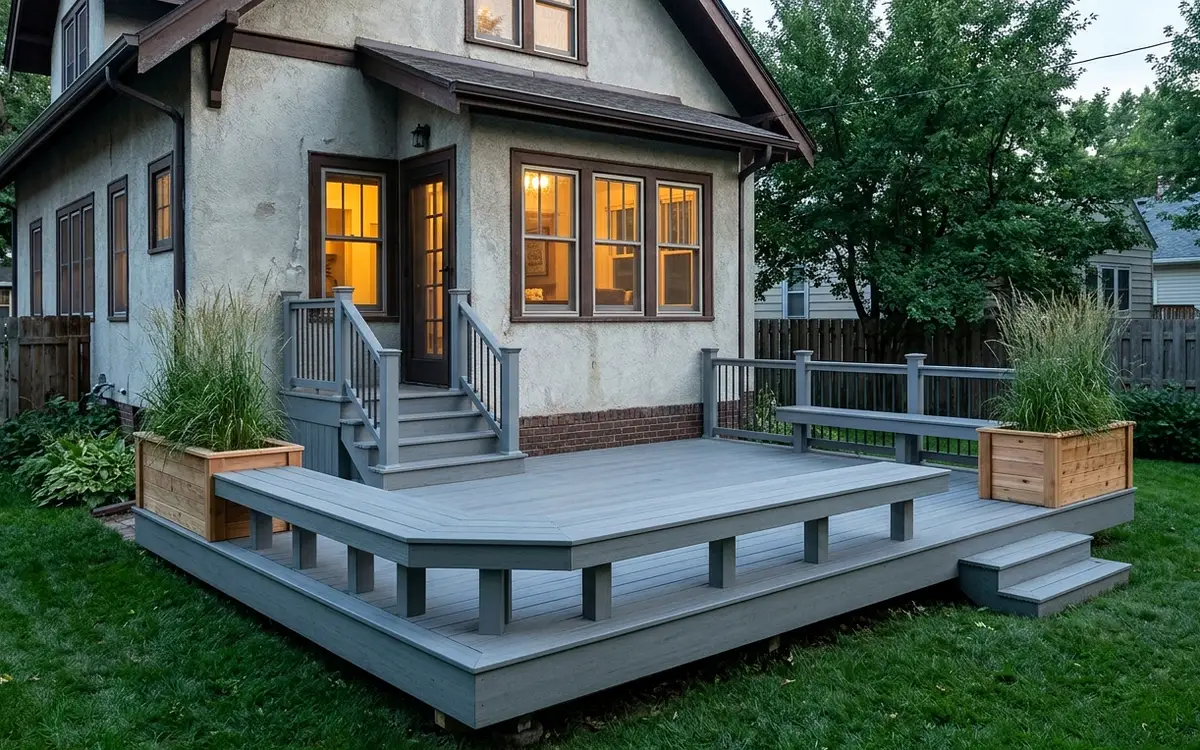
$1,120 to $6,350 per build, based on 2026 Twin Cities jobs.
A built-in bench or planter is framed from the deck structure or anchored to it, then clad in boards that match your decking. We size seats for comfort, line planters to keep wet soil off the framing, and plan the drainage. In Minneapolis a typical project runs $1,120 to $6,350 per build, depending on length, material, backrest style and whether the bench sits against a guard.
Why a framed-in bench works harder than a row of patio chairs
Loose furniture is fine until you notice how much floor it takes. A row of chairs with a side table can swallow a small deck, and every piece has to be stacked somewhere when the snow comes. A built-in bench runs along the edge you already lose to the railing, so the middle of the deck stays open for a grill, a table or kids passing through. We build the seat as part of the frame, which means it won't slide, tip or blow into the yard during a June thunderstorm.
Planters follow the same logic. Pots set right on the boards trap water, stain the surface and hold moisture against the decking for months at a time. A planter box we build sits on spacers or hangs from the frame, with a liner and a drain path that keeps soil and runoff away from the joists. You can grow herbs at counter height next to the grill, or use tall boxes of grasses to soften a long, bare rail line. Each box gets sized to the plants you actually want to grow.
At Revo Deck Systems, most bench and planter work happens during a new build or a resurfacing job, because that's when the framing is open and blocking can go exactly where the seat posts land. We also add them to existing decks in decent shape, as long as the joists under the bench area are sound. Talk to us about how you use the space, how many people you seat on a typical evening and where the afternoon sun hits, and we'll sketch a layout that fits.
Seat, box and board choices that hold up outdoors
Backless perimeter benches
A flat seat about the height of a dining chair, running along the deck edge or around a corner. It works as seating, a step-up spot for kids and a place to set trays. On a raised deck we keep a full guard behind it, measured from the seat.
Benches with angled backrests
A slanted back makes a bench comfortable for a whole evening instead of a few minutes. We set the angle and seat depth for adults, and on raised decks the back can be built tall enough to act as part of the guard where your inspector accepts it.
Lined planter boxes
Boxes built from your deck boards or cedar, with a rubber or plastic liner, drain holes and an air gap below. Corner boxes, rail-top boxes and standalone boxes on spacers are all options, and we size the soil depth to what you plan to grow.
Composite, cedar or PVC cladding
Matching the bench to the floor looks cleanest. Composite from Trex or TimberTech resists splinters and stains, cedar feels warm to sit on but needs sealing, and PVC shrugs off moisture in shady corners. Composite makers back their boards with long limited warranties; we will tell you which one applies.
How we plan and build a bench or planter on your deck
- 01Call
Walk the deck together
We look at how you use the space, where sun and shade fall during the day, and how many people you usually seat. Then we measure every run where benches or boxes could go.
- 02Visit
Check the framing below
On an existing deck we inspect the joists, blocking and fasteners under the planned seat area. Soft or rotted wood gets repaired first, since a bench is only as solid as what holds it.
- 03Scope
Sketch layout and materials
You get a simple drawing with seat heights, box sizes and board choices. We point out anywhere a bench affects guard height, so nothing comes as a surprise at inspection.
- 04Prep
Frame supports and blocking
Seat posts tie into joists or new blocking with structural screws or Simpson Strong-Tie hardware rated for treated lumber. Planter bases get spacers that hold an air gap above the decking.
- 05Build
Clad, line and drain
We wrap the frame in matching boards, hide fasteners where the material allows, and install liners with drain holes aimed away from the joists and the house wall.
- 06Check
Sit test and care notes
We sit on every seat, check for wobble and run a hose through each planter to watch the drainage. You get care notes for the material, including clearing snow off seats.
What built-in benches and planters typically cost
Most built-in bench and planter projects in Minneapolis typically fall from $1,120 to $6,350 per build. A single planter box or a short backless seat sits near the low end, while a long wraparound bench with a backrest and several lined boxes moves toward the top. The real number comes after we see your deck, check the framing underneath and settle on materials with you.
What changes the price
- Total length of bench seating and whether it turns corners or wraps around posts
- Backless seat versus an angled backrest that also works as part of a guard
- Board material, since cedar, composite and PVC are each priced differently per foot
- Number, size and soil depth of planter boxes, plus liners and drain hardware
- Condition of the joists and blocking under the seat area on an existing deck
- Extras such as hidden fasteners, step lights under the seat or lift-up storage lids
When a built-in bench or planter makes sense for your deck
Chairs crowd the walking path
If guests have to turn sideways to get from the patio door to the stairs, loose seating is in the way. A perimeter bench moves that seating to the edge and opens up the center.
Pots are staining your boards
Dark rings, soft spots or mildew under flower pots mean water is sitting on the decking. Raised, lined boxes keep wet soil off the surface and let boards dry between rains.
You haul furniture every November
Carrying chairs to the garage each fall and back out each May gets old fast. A built-in bench stays put all year and only needs a quick brush of snow.
A long railing looks bare
A long, unbroken run of balusters can make a deck feel like a hallway. Planter boxes or a corner bench break up that line and give the eye somewhere to rest.
Resurfacing is already on the calendar
When the old boards come off, the joists are exposed. That's the lowest-cost moment to add blocking and seat supports, since nothing finished has to be torn up to reach them.
The hot tub needs a perch
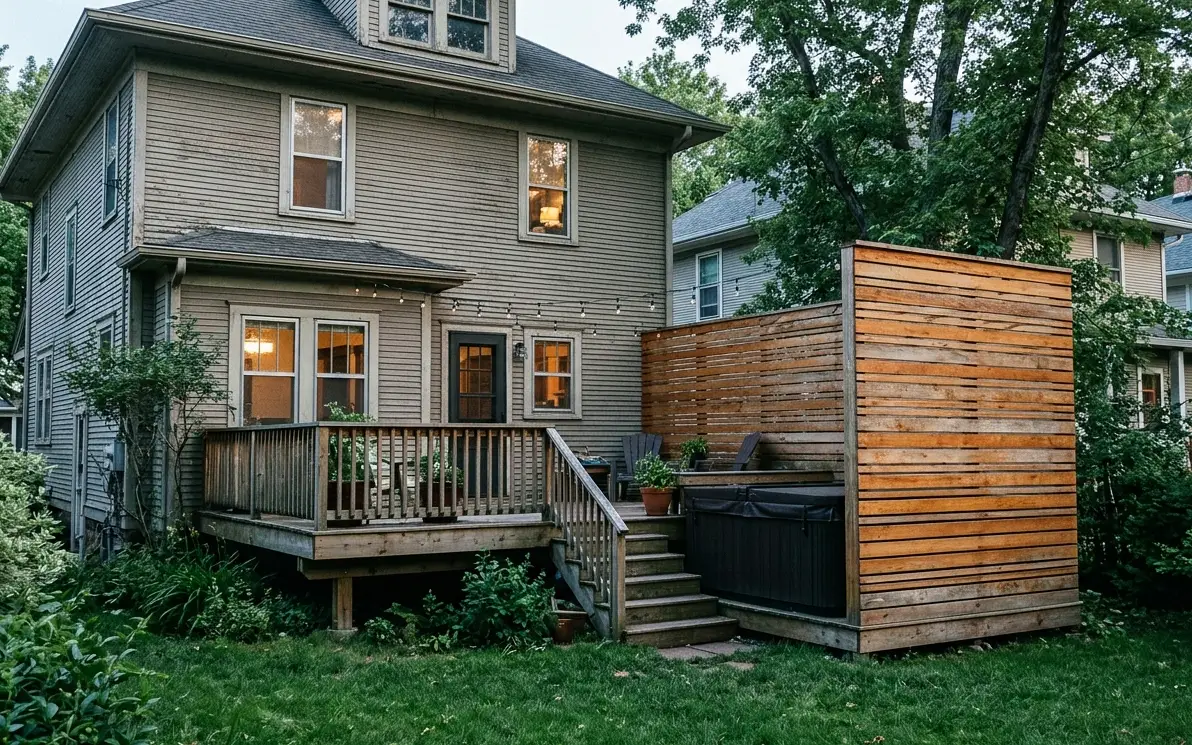
A bench beside a hot tub gives you somewhere to sit while drying off and a ledge for towels. We frame it for wet feet, dripping swimsuits and heavy daily use.
Benches and planters built for Twin Cities snow and short summers
A bench on a Minneapolis deck spends a good part of the year under snow, so we frame it like part of the deck floor, not like patio furniture. Seat boards get the same spacing as the decking so meltwater drains instead of pooling and refreezing overnight. We skip wide flat caps that hold ice through the freeze-thaw swings of March and November. If you clear the deck in winter, use a plastic shovel or calcium magnesium acetate near the bench, and check the board maker's care sheet before reaching for rock salt.
Planter boxes face a different problem: wet soil that freezes solid. A full box expands in January, and a tightly built box can push its own corners apart. We leave room for that movement, use liners that keep soil off the wood, and suggest emptying or covering smaller boxes before the first hard frost. On the tall second-story decks common in Maple Grove, Plymouth and Woodbury, rail-top boxes stay small and light so they don't strain the guard. On shaded lots near the Chain of Lakes, we pick finishes that tolerate damp air.
Where we do benches & planters around Minneapolis
Benches & Planters jobs take our carpenters to these cities and neighborhoods most weeks, and to the rest of the metro too.
- Minneapolis 55414
- Saint Paul 55102
- Bloomington 55420
- Brooklyn Park 55443
- Plymouth 55447
- Woodbury 55125
- Maple Grove 55369
- Lakeville 55044
- Blaine 55434
- Eagan 55122
- Burnsville 55337
- Eden Prairie 55344
- Coon Rapids 55433
- Apple Valley 55124
- Edina 55424
- Minnetonka 55305
- St. Louis Park 55416
- Shakopee 55379
- Maplewood 55109
- Cottage Grove 55016
- Richfield 55423
- Roseville 55113
- Inver Grove Heights 55076
- Andover 55304
- Savage 55378
- Fridley 55432
- Chanhassen 55317
- Prior Lake 55372
Questions about benches & planters
Can you add a built-in bench to my existing deck without replacing the boards?
Usually, yes. We lift a few boards where the seat posts land, add blocking between the joists and fasten the supports to that blocking. If your boards are close to the end of their life, adding the bench during a resurfacing job is the better spend, because the framing is already exposed and the new seat will match the new floor.
How high should a built-in deck bench be, and does it change my railing height?
Comfortable seats usually sit around 17 to 19 inches above the deck floor. When a bench backs up to a guard on a raised deck, a child can stand on the seat, so we plan the guard height from the seat surface. Your inspector has the final word, and we draw the detail so it can be reviewed before we build anything.
Will a built-in deck planter box rot the boards or joists underneath it?
Not if it's built right. We line every box, drill drain holes and lift the base on spacers so air moves between the box and the decking. Water exits to the side, away from the joists and the house. Pots set directly on boards cause a lot of the soft spots we find on older decks, because they hold moisture for weeks.
What should I do with built-in deck planters before winter in Minneapolis?
Small boxes are easiest to empty or cover so the soil doesn't freeze and push the corners apart. Larger lined boxes can stay planted as long as the drain holes stay clear. Cut back dead growth, keep shoveled snow from piling against the box sides, and avoid rock salt nearby. A plastic shovel works fine around the corners.
Can a built-in deck bench include storage for cushions and toys?
It can, with a hinged lid and a vented box underneath. Outdoor storage benches never stay completely dry, so we slope the base, add vents and suggest keeping cushions in a sealed bin inside. Composite lids are heavy, so we add a lid stay to hold them open. Talk to us about what you want to store and we'll size the box around it.
Talk to us about benches & planters
Call any hour about benches & planters, tell us what you are seeing, and we will set a time to look and write up a scope.