Railings & Details · Minneapolis, MN
Deck ramps and accessible access in Minneapolis
The steps to your deck or back door have become the hard part of leaving the house, for a wheelchair, a walker, a stroller or a stiff knee.
We build wood and composite ramps with gentle slopes, level landings and graspable handrails, tied into your existing deck or porch.
- Phones answered 24/7
- Written scope before work starts
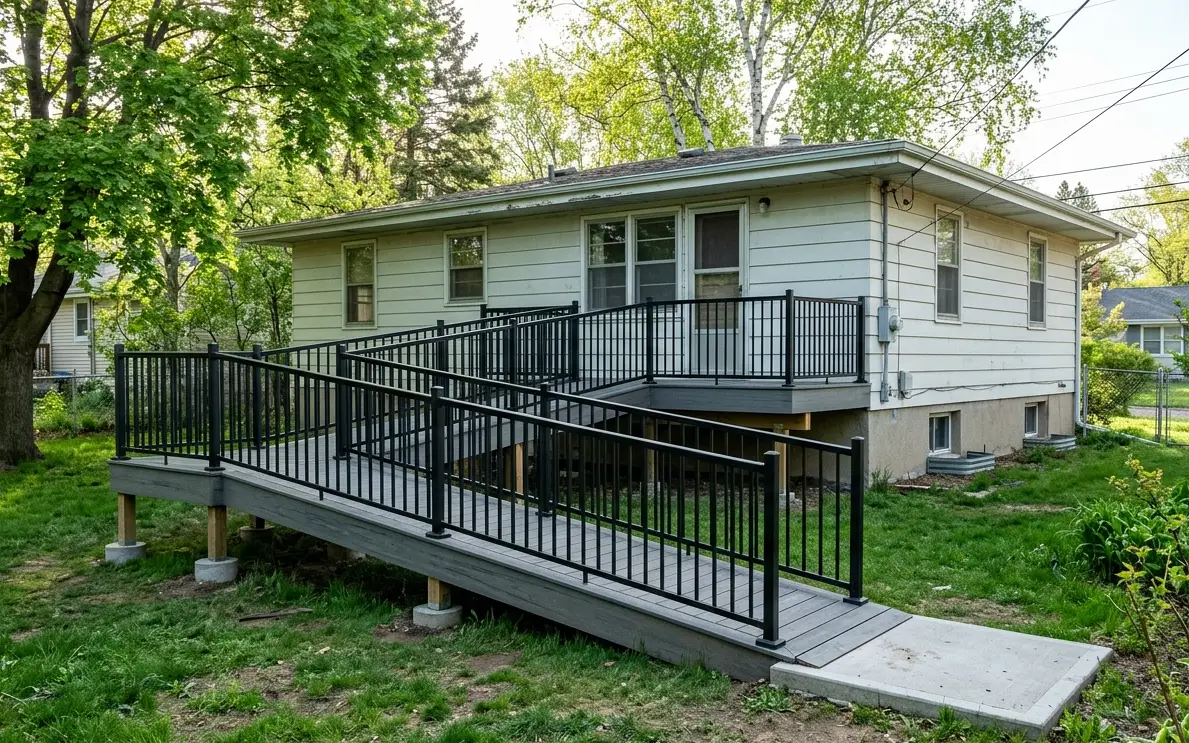
$2,780 to $9,450 per ramp, based on 2026 Twin Cities jobs.
A deck ramp replaces or sits beside stairs, giving a gradual sloped path with level landings and handrails. The common guideline is a 1:12 maximum slope, one inch of rise per foot of run, so a 24-inch rise needs about 24 feet of ramp plus landings. In Minneapolis, a typical ramp costs $2,780 to $9,450 per ramp, depending on rise, length, turns and materials.
How a well-planned ramp gets you from the door to the yard
A ramp looks simple until you do the math. At the common 1:12 guideline, every inch of height takes a foot of run, so a deck 30 inches up needs about 30 feet of slope, plus landings at the top, the bottom and any turn. That length has to fit your yard, stay clear of the roof drip line and end somewhere useful, like the driveway or the garage door. We start with that layout, because a ramp that fights the yard ends up too steep or too long to use.
The 1:12 figure comes from public accessibility guidelines, and it's a slope many wheelchair users can manage on their own. Private homes aren't generally held to that exact number, but we treat it as the target because steeper ramps get hard to climb and risky to come down. Where space allows, we go gentler. Landings give you a flat place to rest, open a door or turn a chair, and we size them so a wheelchair or walker fits without scraping the rails.
Surface and rails matter as much as slope. We use textured boards or grit strips, keep board gaps tight enough for cane tips and small wheels, and run graspable handrails on both sides at a steady height. Edge curbs keep wheels from slipping off the side. A ramp can be a permanent part of the deck or porch, or a set of modular sections that comes apart later. Phone us to talk through who will use it and how, and we'll plan around that person.
Ramp layouts and materials for different homes
Straight run ramps
The simplest layout: one sloped run from the deck to the ground with a landing at each end. It works on deep yards or along the side of a house, and it's the easiest kind of ramp to roll a chair up without stopping.
Switchback ramps with landings
When a straight run won't fit, the ramp folds back on itself with a level landing at every turn. That packs more length into a compact yard, which matters on the narrow city lots found across much of Minneapolis.
Wood or composite surfaces
Pressure-treated framing with composite decking gives a solid, low-upkeep ramp that matches your deck. Cedar or treated boards cost less up front but need sealing and grit coatings to stay slip-resistant through wet spring and fall weather.
Modular aluminum sections
Bolted aluminum ramp sections go up quickly and come apart if your needs change, which suits a recovery period. We still set them on proper footings or pads and tie them to the deck so nothing shifts underfoot.
How a ramp project runs, from measuring rise to the roll test
- 01Call
Measure the rise
We measure from the deck or porch floor down to where the ramp will end, then work out run length, landings and turns using the 1:12 guideline as the target.
- 02Visit
Plan around the user
We ask who will use the ramp, with what device, and where they need to go. Chair width, turning space and door swings decide how big each landing gets.
- 03Scope
Draw it and file permits
A ramp attached to a deck often needs a permit, just like the deck. We prepare the drawings, file them and schedule the footing and framing inspections.
- 04Prep
Dig footings below frost
Ramp posts bear on footings dug to the 42-inch frost depth, so the slope stays true through winter and the landings don't heave out of level.
- 05Build
Frame, deck and rail
We frame the run and landings, lay slip-resistant boards with tight gaps, add edge curbs and install graspable handrails on both sides at one consistent height.
- 06Check
Roll test and walkthrough
We roll a chair or cart up and down, check for bounce or lips at each transition, and show you how to clear snow from the surface without gouging it.
What a deck ramp typically costs in the Twin Cities
A deck or porch ramp in Minneapolis typically costs $2,780 to $9,450 per ramp. A short straight run on a low rambler deck sits near the low end, while a long switchback with several landings, composite boards and rails on both sides moves toward the top. The real number comes after we measure the rise, look at your yard and talk through who will use the ramp every day.
What changes the price
- Total rise, which sets the overall ramp length at the 1:12 guideline
- Number of landings and turns needed to fit the run into your yard
- Decking and rail material, from treated wood to composite and aluminum
- Footings dug to frost depth for every post along the run
- Permit drawings, inspections and any changes to existing stairs or doorways
- Extras such as edge curbs, grit strips, rail lighting or a self-closing gate
Signs your home needs a ramp instead of steps
Someone now uses a wheelchair
A new wheelchair, scooter or power chair means the stairs are no longer an option. A ramp gives that person their own way in and out without being lifted or carried.
Steps feel shaky with a walker
Lifting a walker one step at a time is slow and unsteady, especially on wet or icy treads. A gentle slope with rails on both sides is easier and much steadier.
Surgery recovery is coming up
Knee, hip or back surgery can make steps difficult for months. Planning a ramp before the procedure means coming home to a clear path into the house on day one.
You plan to age in place
If you want to stay in your home for many years, a ramp to the deck or porch is one of the most useful changes to make before mobility becomes a problem.
Strollers and carts keep bumping
Hauling a stroller, garden cart or grill up and down steps wears out arms and stair treads alike. A ramp makes rolling loads simple for everyone in the household.
Visitors hesitate at your stairs
When grandparents or friends with limited mobility pause at the bottom of your steps, a ramp lets them join gatherings without anyone having to help them up.
Ramps that stay usable through a Minneapolis winter
A ramp only helps if it works in January. Snow and ice make any slope harder, so we design for clearing: no tight corners a shovel can't reach, rails spaced to leave room for a snow pusher, and boards that tolerate a plastic shovel. Rock salt pits some decking, so we suggest calcium magnesium acetate and point you to the board maker's care sheet. Revo Deck Systems also sets every ramp footing at the 42-inch frost depth, so freeze-thaw cycles in March and November don't twist the run or tilt a landing.
The style of house shapes the ramp. Older bungalows and foursquares in Southwest, Longfellow and Northeast often have a tall front porch and a small yard, so we plan switchbacks along the side or route the ramp to a rear deck closer to the alley garage. Post-war ramblers in Nokomis and the inner-ring suburbs sit lower to the ground, which keeps ramps short. On walkout homes in Maple Grove or Lakeville, the main deck may be a full story up, so the easier route is often a ramp to the front entry instead.
Where we do deck ramps around Minneapolis
Deck Ramps jobs take our carpenters to these cities and neighborhoods most weeks, and to the rest of the metro too.
- Minneapolis 55414
- Saint Paul 55102
- Bloomington 55420
- Brooklyn Park 55443
- Plymouth 55447
- Woodbury 55125
- Maple Grove 55369
- Lakeville 55044
- Blaine 55434
- Eagan 55122
- Burnsville 55337
- Eden Prairie 55344
- Coon Rapids 55433
- Apple Valley 55124
- Edina 55424
- Minnetonka 55305
- St. Louis Park 55416
- Shakopee 55379
- Maplewood 55109
- Cottage Grove 55016
- Richfield 55423
- Roseville 55113
- Inver Grove Heights 55076
- Andover 55304
- Savage 55378
- Fridley 55432
- Chanhassen 55317
- Prior Lake 55372
Questions about deck ramps
How long does a deck ramp need to be for a wheelchair?
At the common 1:12 guideline, plan on one foot of ramp for every inch of rise. A deck 20 inches up needs about 20 feet of slope, plus a level landing at the top and bottom. Longer runs also need rest landings along the way. We measure your actual rise and lay out the full length before you commit to anything.
Is the 1:12 slope a legal requirement for a home deck ramp?
For private homes it's generally treated as the common guideline rather than a strict rule; the 1:12 figure comes from public accessibility standards. We still aim for it, or gentler, because steeper ramps are hard to climb alone and risky going down. Your city may have rules on rails, landings and footings, and we follow whatever the permit calls for.
Can a deck ramp replace my existing deck stairs?
Sometimes, though often the stairs should stay. Many households keep the stairs for quick trips to the yard and add the ramp on another side. If the yard is tight, we can remove the stairs and start the ramp from the same opening. Either way, we tie the ramp into the deck frame and match the railings so it looks planned.
How do I keep a deck ramp safe from ice in the winter?
Shovel early, before snow packs down, and use a plastic shovel on composite boards. Calcium magnesium acetate melts ice with less harm than rock salt on most decking, but check the board maker's care sheet first. We add grit strips or textured boards and keep handrails clear of the path, so you always have something solid to hold.
Should I choose a wood deck ramp or a modular aluminum ramp for short-term use?
If the need is temporary, like a few months after surgery, modular aluminum makes sense because it comes apart and can be reused or sold. For long-term use, a framed wood and composite ramp feels more solid underfoot and matches the deck. We set either type on proper support and tie it to the structure so it doesn't shift.
Talk to us about deck ramps
Call any hour about deck ramps, tell us what you are seeing, and we will set a time to look and write up a scope.