Repair & Replacement · Minneapolis, MN
Ledger board repair and flashing in Minneapolis
The ledger is the one board that holds your deck to the house, and on many older Minneapolis decks it has been rotting quietly behind the siding for years.
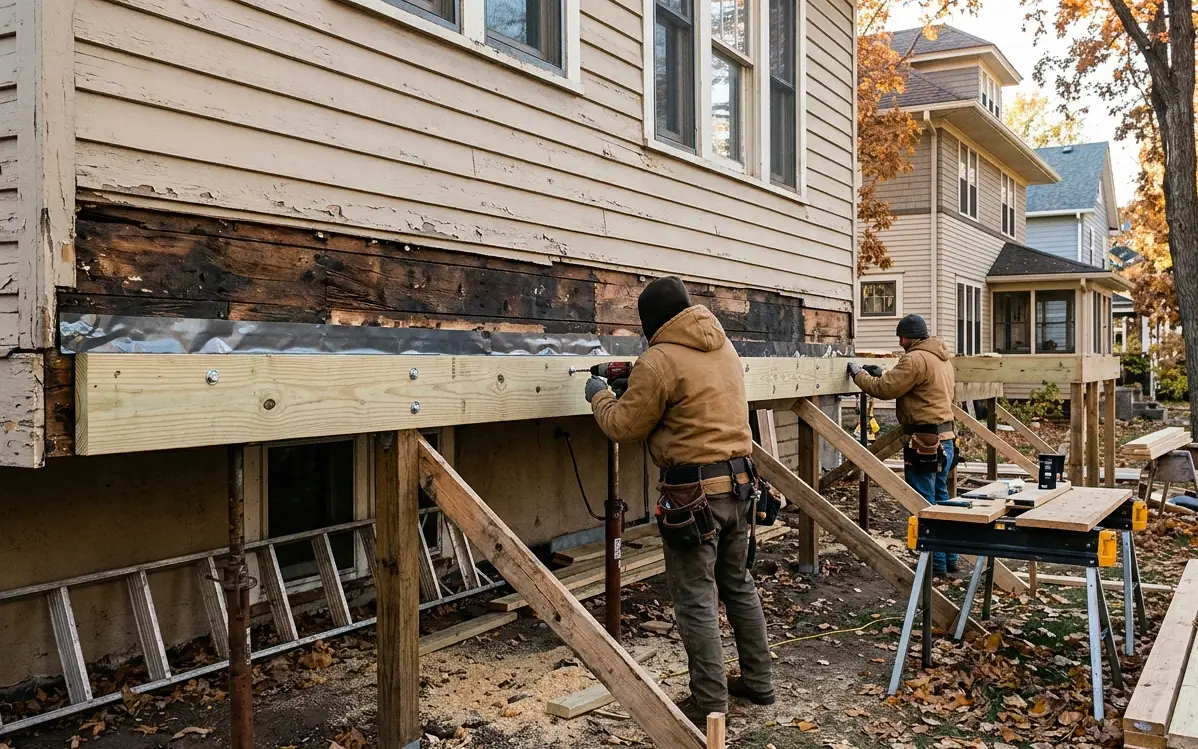
We support the deck, pull the old ledger, repair the house framing behind it, then flash and bolt a new one properly.
- Phones answered 24/7
- Written scope before work starts
$1,740 to $6,380 per ledger repair, based on 2026 Twin Cities jobs.
Ledger board repair replaces the board that attaches a deck to the house and fixes the rot it often leaves in the house rim joist. The work includes shoring the deck, removing siding at the ledger line, new flashing, a new ledger and through-bolts or structural screws. In Minneapolis it typically runs $1,740 to $6,380 per ledger repair, depending on rot behind it and deck height.
Signs of a rotted or failing ledger board
Gap between deck and house
A space opening between the ledger and the siding means the fasteners are pulling out. Even a small gap that grows over a season is a warning to stay off.
Nails, not bolts, at the ledger
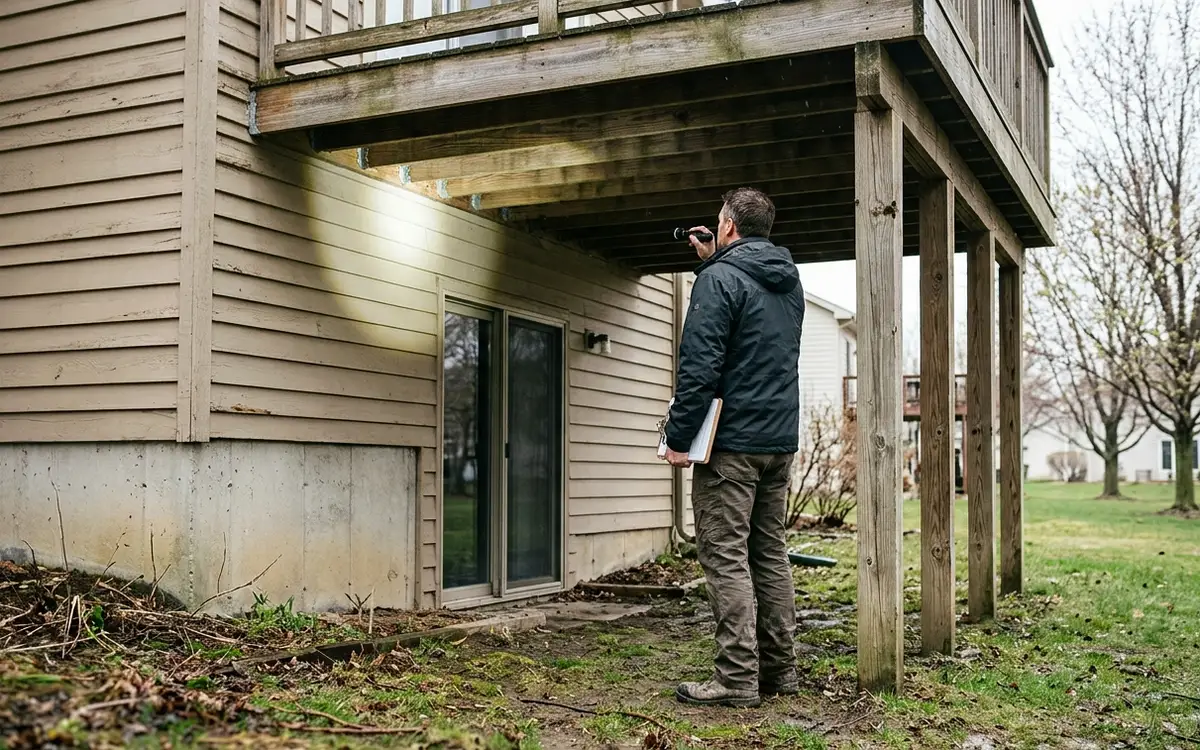
Look under the deck where the ledger meets the house. If you see only nail heads and no bolts or structural screws, the attachment falls short of current practice.
No flashing above the ledger
There should be metal or membrane flashing tucked behind the siding and lapped over the ledger. Bare siding meeting bare wood lets water straight into the joint.
Dark stains below the deck
Streaks, peeling paint or soft spots on the siding and foundation under the ledger line show where water has been running behind it for years.
Water in the basement rim
Damp spots, stains or soft wood on the inside of the rim joist, right behind where the deck attaches, often mean the ledger joint has leaked for a long time.
Joists sagging at the house
If the deck dips near the wall rather than at the outer beam, the ledger or its hangers may be failing. Keep weight off that edge and have it checked soon.
Why the ledger is where most attached decks let go
Every attached deck hangs one side of its frame on the ledger, and the ledger hangs on the house. If that connection fails, the whole edge of the deck can drop at once. That is why we treat ledger problems differently from a soft board or a loose baluster. A ledger that is rotted, pulling away or held on only with nails needs attention before the next party, the next heavy snow or the next season of use.
Many decks built in the 1980s and 1990s were attached with nails and no flashing. Water running down the siding gets behind the ledger, sits there, and rots both the ledger and the rim joist of the house. You often can't see it from the deck. From the yard, look for dark staining below the ledger, siding that bulges near the deck line, or a gap opening between the ledger and the wall. Inside, water spots on the basement rim can be the first clue.
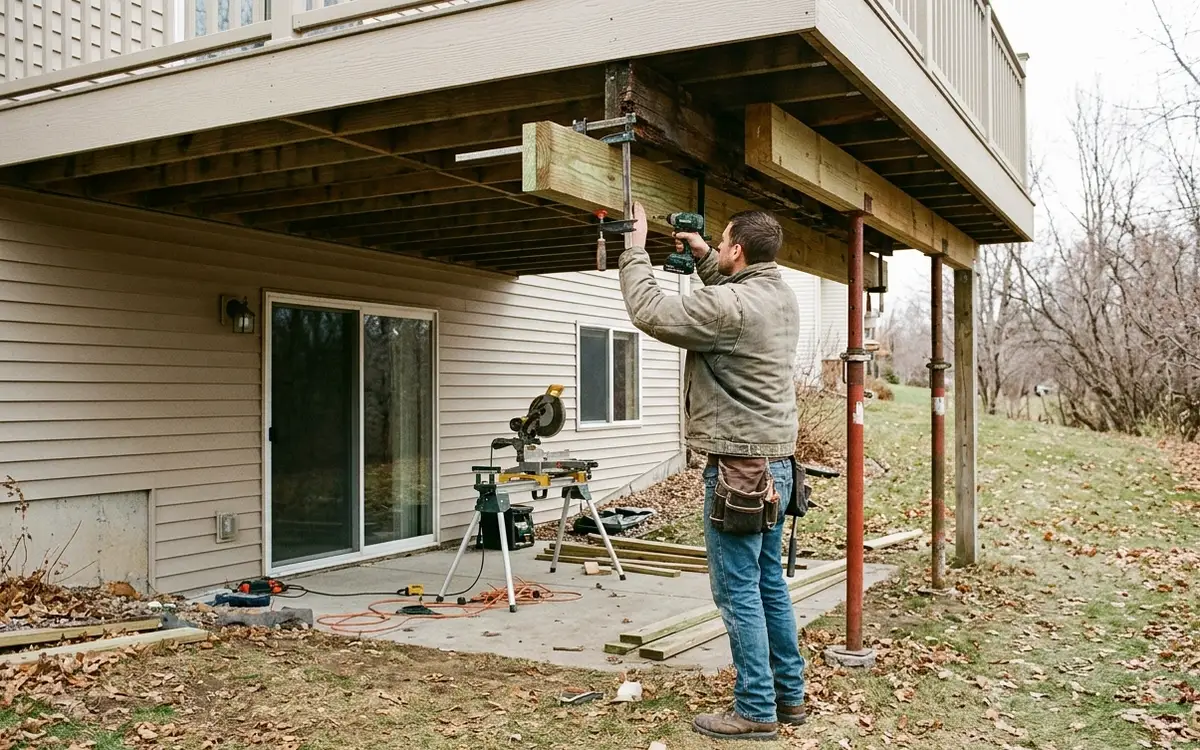
The repair is careful work because it touches the house. We shore the deck so it stands on its own, open the siding at the ledger line, remove the old board and check the rim joist and sheathing behind it. Rotted house framing gets cut out and replaced. Then we install layered flashing, a new treated ledger and through-bolts or structural screws from FastenMaster or Simpson Strong-Tie. If your deck is pulling away from the house, keep everyone off it and call us, day or night.
How we replace a ledger without dropping the deck
- 01Call
Phone us and stay off
Call day or night. If the deck is pulling away from the house or sagging near the wall, keep everyone off it and away from the area below.
- 02Visit
Inspect inside and out
We look at the ledger from below, check the fasteners and flashing, and, with your permission, look at the basement rim joist behind it for water damage.
- 03Scope
Shore the deck
A temporary beam and posts go in near the house so the deck stands on its own. Nothing gets cut until the shoring is carrying the load.
- 04Prep
Open the wall and repair
Siding comes off along the ledger, the old board comes down, and any rotted rim joist or sheathing is replaced. Permits get pulled when the work is structural.
- 05Build
Flash and bolt the new ledger
Layered flashing goes on first, then the new treated ledger with through-bolts or structural screws in the right pattern. Joists are rehung in new rated hangers.
- 06Check
Close up and walk through
We reinstall or match the siding, pull the shoring, and show you the new connection from below before we haul off the debris.
What ledger board repair typically costs
Ledger board repair in Minneapolis typically runs $1,740 to $6,380 per ledger repair. Reflashing and bolting a sound ledger on a low deck sits near the bottom. Replacing a long ledger, repairing rot in the house rim joist, or working on a tall second-story deck moves it toward the top. The real number comes after we see the deck and open the siding along the ledger line.
What changes the price
- Length of the ledger and the number of joists to rehang
- Extent of rot in the house rim joist and sheathing behind it
- Siding type, since vinyl, wood, stucco and brick open differently
- Deck height and the shoring needed close to the house wall
- Fastener choice, through-bolts or structural screws, set by wall access
- Converting to a freestanding beam when the wall cannot carry a ledger
Ledger repair options that match what we find behind the siding
Reflash and add through-bolts
When the ledger and rim joist are still solid, we remove siding at the ledger line, install new layered flashing and add through-bolts or structural screws. It is the lightest fix and only works on sound wood.
Full ledger replacement
A soft or split ledger comes off while the deck rests on shoring. We set a new treated ledger with proper spacers, flashing and fasteners, then rehang the joists in new rated hangers.
House rim joist repair
Rot often spreads into the house band board behind the ledger. We cut out soft sections, install new framing and sheathing, and seal the wall before the new ledger goes on.
Freestanding beam conversion
Some walls cannot carry a ledger, such as brick veneer or a cantilevered floor. In those cases we add a beam and footings near the house so the deck stands on its own instead.
Ledger problems we see on Minneapolis homes
Minneapolis has a lot of 1900 to 1930 bungalows, foursquares and Tudor revival homes in Southwest, Longfellow and Northeast, and many of them got rear decks decades later. Those additions were often nailed to the house with no flashing, sometimes right over the old siding. Months of snow piled against the wall and repeated thaws in March and April feed water into that joint every year. By the time a homeowner notices a gap or a soft spot, the ledger and part of the house rim have usually been wet for a long time.
Post-war ramblers and Cape Cods in Nokomis, Camden and Northeast, and the 1950s and 1960s homes in Richfield, Robbinsdale and Columbia Heights, show the same pattern on lower decks. Out in the suburbs, tall decks on 1980s to 2000s walkout homes in Lakeville and Maple Grove hang a lot of weight on one ledger, so a failure there is more dangerous. Minneapolis and most suburbs require a permit for structural ledger work on an attached deck, and we take care of the drawings and inspections for you.
Where we do ledger board repair around Minneapolis
Ledger Board Repair jobs take our carpenters to these cities and neighborhoods most weeks, and to the rest of the metro too.
- Minneapolis 55414
- Saint Paul 55102
- Bloomington 55420
- Brooklyn Park 55443
- Plymouth 55447
- Woodbury 55125
- Maple Grove 55369
- Lakeville 55044
- Blaine 55434
- Eagan 55122
- Burnsville 55337
- Eden Prairie 55344
- Coon Rapids 55433
- Apple Valley 55124
- Edina 55424
- Minnetonka 55305
- St. Louis Park 55416
- Shakopee 55379
- Maplewood 55109
- Cottage Grove 55016
- Richfield 55423
- Roseville 55113
- Inver Grove Heights 55076
- Andover 55304
- Savage 55378
- Fridley 55432
- Chanhassen 55317
- Prior Lake 55372
Questions about ledger board repair
How can I tell if my deck ledger board is rotted without removing it?
Start from below. Push a screwdriver into the bottom edge of the ledger and the house rim beside it. Look for nails instead of bolts, missing flashing and dark staining on the siding or foundation. Inside the basement, check the rim joist behind the deck for water marks. Any one of these is reason to have us look closer.
Does ledger board repair mean removing my siding?
Some siding has to come off along the ledger line, because flashing only works when it tucks behind it. On vinyl and wood siding we remove and reinstall pieces or replace them to match. Stucco and brick take more care and sometimes favor a freestanding beam instead. We'll show you exactly how much comes off before we start.
Can a ledger repair be done in winter in Minneapolis?
Yes, and sometimes it should be. A ledger that is pulling away under snow load is not something to leave until May. We shore the deck, open the wall on a dry day and close it up the same day or the next. Flashing membranes and sealants are chosen for cold-weather installation so they bond properly.
What happens if ledger rot has reached my house framing?
We cut out the soft sections of rim joist and sheathing and replace them with new framing before the new ledger goes on. It adds cost, which is part of why the range for this work is wide. If the damage runs further into the floor system, we stop, show you what we found and price it before continuing.
Why are nailed deck ledgers a problem on older houses?
Nails hold poorly when they are pulled straight out, and a deck ledger gets pulled outward when people gather near the outer edge. Over time, frost movement and moisture loosen them further. Current practice uses through-bolts or rated structural screws in a set pattern, plus flashing, which is why older nailed ledgers are a common repair.
Talk to us about ledger board repair
Call any hour about ledger board repair, tell us what you are seeing, and we will set a time to look and write up a scope.