Repair & Replacement · Minneapolis, MN
Deck stair building and repair in Minneapolis
A bouncing tread, a stringer gone soft at the bottom or a rail that wobbles in your hand means the stairs off your deck are no longer safe to trust.
We rebuild stair runs with new stringers, solid landings and even risers, and if a step is failing, keep everyone off it and call any hour.
- Phones answered 24/7
- Written scope before work starts
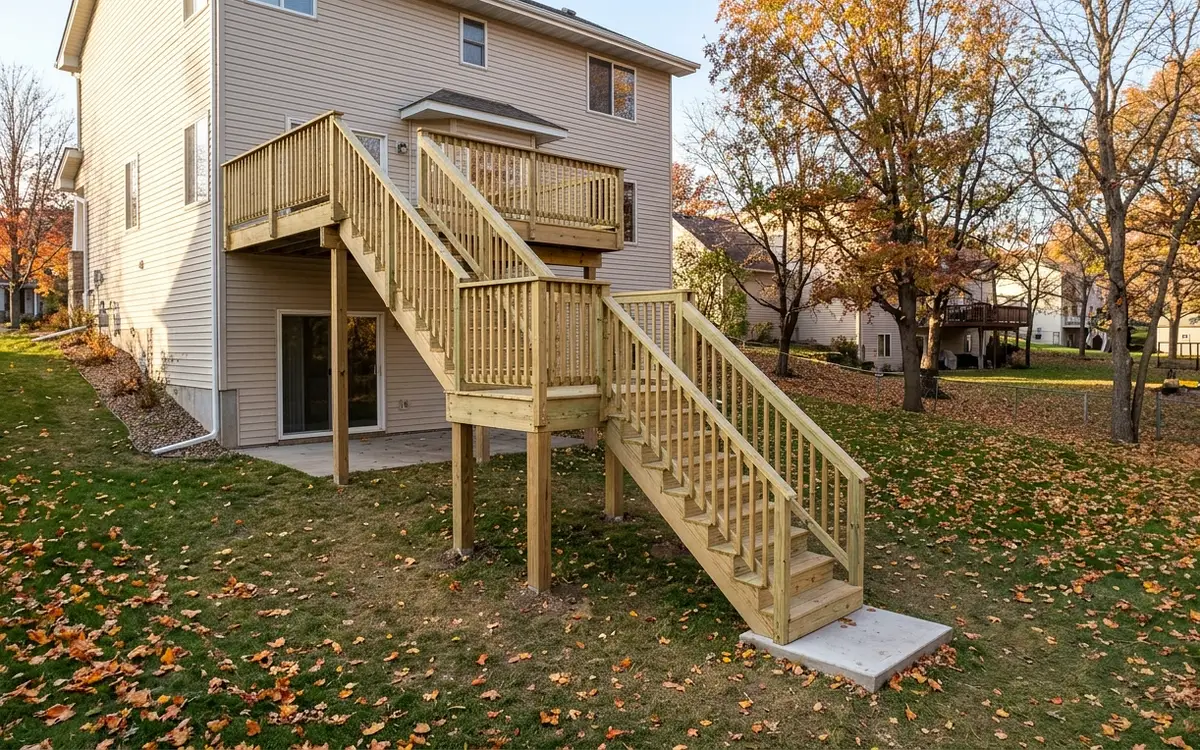
$1,460 to $6,920 per stair run, based on 2026 Twin Cities jobs.
Deck stair work means cutting new stringers, setting a stable landing or footing at the bottom, fitting treads and risers to code height, and adding a graspable handrail and guards. In Minneapolis a typical job runs $1,460 to $6,920 per stair run, depending on height, width, landings and materials. Short repairs sit low in that range; tall walkout runs with a mid-flight landing sit high.
When your deck stairs need attention now
Treads that bounce or crack
A tread that flexes under one foot usually means the stringers are spaced too far apart, or the board has started to rot from the underside where water sits.
Stringers soft near the ground
Push a screwdriver into the bottom few inches of each stringer. If it sinks in easily, the wood is rotting where it meets soil, concrete or a puddle.
Handrail moves when you grab it
Your handrail is there to catch you on ice. If it shifts, rattles or pulls loose from its posts, it won't do that job on the day you need it.
Run pulling away from deck
A gap opening between the top of the stringers and the deck rim means the connection is failing. Keep everyone off the stairs and call us any hour.
Risers of uneven height
Frost heave or a sinking landing can leave the bottom step taller or shorter than the rest, and that one uneven step is where people trip.
Rusted or missing hangers
Orange streaks, flaking metal or bare nails where hangers should be tell us the hardware is corroding against treated lumber and losing its hold.
Why deck stairs fail before the rest of the deck
Stairs take more abuse than any other part of a deck. Every trip to the grill or the yard puts weight on the same few treads, and the bottom of the stringers sits closest to wet soil, melting snow and splashing rain. We often find a deck frame that still has years left while the stair stringers below it have softened into something you can push a screwdriver into. That's why a stair run can fail suddenly even when the deck above feels solid underfoot.
Many older stairs were built with notched two-by stringers cut so deeply that very little wood is left at each step. Others were hung from the rim joist with a few nails and no hanger at all. Some simply rest on a patio block that shifts every spring. Any one of those details can let a run twist, sag or pull away from the deck, and stairs that move are the ones people fall on.
We look at the whole run, top to bottom: how the stringers attach, what they land on, how the treads are fastened, and whether the handrail would hold you if you slipped. Sometimes a repair is a new set of treads and a tightened rail. More often the safe fix is a new run framed to current code, with hardware rated for treated lumber. Call us and describe what you see, and we'll tell you which one it sounds like.
How a stair rebuild runs from first call to final step
- 01Call
Phone call and photos
You call and describe the stairs. If they sound unsafe, we tell you to tape them off right away, and we get out to look as soon as we can.
- 02Visit
Measure total rise
We measure from the deck surface to the ground at the landing spot, then divide that height into equal risers and treads that meet code.
- 03Scope
Set the landing
The bottom of the run gets a stable base: a poured pad, a frost footing or a compacted landing, depending on the height and what the permit calls for.
- 04Prep
Cut and hang stringers
New stringers are cut from sound lumber, spaced for the tread material you chose, and fastened to the deck rim with rated hangers and structural screws.
- 05Build
Treads, risers and rails
Treads go on with hidden or face fasteners, then we add a graspable handrail and guards that stay firm when you lean your weight into them.
- 06Check
Walk it with you
Before we leave, you walk the stairs with us. We check every riser height, tug every rail post and haul off the old lumber and cut scraps.
What deck stairs typically cost and why the number moves
Most stair jobs we see in Minneapolis run $1,460 to $6,920 per stair run. That is a typical range, not a quote. Height drives most of it, since a taller deck means more risers, longer stringers and often a landing. Width, tread material and how much rail is involved move it too. We give you a real number after we see the deck and measure the drop.
What changes the price
- Total rise from deck surface to grade, which sets the number of steps
- Whether the run needs a mid-flight landing on a tall walkout deck
- Stair width, from a single-person run to a wide flared entry
- Tread material: pressure-treated lumber costs less than composite or PVC boards
- Length of handrail and guard, and whether it has to fit an existing railing style
- What the bottom of the run lands on: a pad, a frost footing or helical piers
Stair layouts and materials that hold up to Minnesota winters
Straight run to grade
The simplest layout is one run from the deck down to a landing pad at the bottom. It suits decks up to about one story tall and keeps both cost and yard footprint down.
Switchback with mid landing
Tall walkout decks often need a landing partway down so the stairs turn back on themselves. That landing gives you a resting spot, shortens each run and keeps the stairs from reaching deep into the yard.
Wide or flared steps
A wider run, or one that flares out at the bottom, makes a deck feel connected to the lawn and is easier to use when you are carrying a tray or a cooler. It also leaves room to shovel.
Composite or wood treads
Pressure-treated treads cost less and can be stained to suit the deck. Composite treads from makers like Trex or TimberTech resist splintering and rot, but they need closer stringer spacing, which we build in from the start.
What frost and snow do to stairs in the Twin Cities
Minnesota code wants deck footings below frost depth, which is 42 inches in the Twin Cities. Stairs are where that rule most often gets skipped. A landing that sits on a paver or a thin slab rises and drops with every freeze-thaw swing in March, April and November, and the stringers above it rack a little more each year. When we rebuild a run, the base it lands on gets as much attention as the steps themselves, because a heaving base is what loosens everything else.
Snow is the other test. A stair run on a north-facing deck can hold packed snow and ice for most of the winter, and rock salt thrown on it pits some boards and speeds up hardware corrosion. We suggest calcium magnesium acetate or a plastic shovel instead, after checking the tread maker's care sheet. On outer-suburb walkouts in Maple Grove, Plymouth or Woodbury, where stairs drop a full story or more, we often add a mid-flight landing so a slip doesn't turn into a long fall.
Where we do deck stairs around Minneapolis
Deck Stairs jobs take our carpenters to these cities and neighborhoods most weeks, and to the rest of the metro too.
- Minneapolis 55414
- Saint Paul 55102
- Bloomington 55420
- Brooklyn Park 55443
- Plymouth 55447
- Woodbury 55125
- Maple Grove 55369
- Lakeville 55044
- Blaine 55434
- Eagan 55122
- Burnsville 55337
- Eden Prairie 55344
- Coon Rapids 55433
- Apple Valley 55124
- Edina 55424
- Minnetonka 55305
- St. Louis Park 55416
- Shakopee 55379
- Maplewood 55109
- Cottage Grove 55016
- Richfield 55423
- Roseville 55113
- Inver Grove Heights 55076
- Andover 55304
- Savage 55378
- Fridley 55432
- Chanhassen 55317
- Prior Lake 55372
Questions about deck stairs
Can you repair just the deck stair treads, or does the whole stair run need replacing?
If the stringers are sound and properly attached, swapping cracked or soft treads is a smaller job and often the right one. We check the stringers first, though. New treads on rotting stringers only hide the problem for a season, so we tell you plainly if the run itself needs to come out and be rebuilt.
Do rebuilt deck stairs in Minneapolis need a permit?
A stair rebuild is often part of a permitted deck job, and new runs on attached or raised decks usually fall under the same permit rules as the deck itself. We handle the drawings and the permit when one is needed and schedule the inspections. For a simple tread swap, we check with the city before assuming no permit applies.
What should I do if my deck stairs feel loose late at night?
Keep everyone off them, including pets, and block the top with a chair or a strip of tape. Use a different door to get in and out. Then call us. The phone is answered 24/7, and we can talk you through whether the run looks ready to let go or can safely wait for a daytime visit.
How long does a deck stair rebuild take once work starts?
A straight run on a low deck is often one to two working days, including pulling the old stairs. A tall run with a landing and a new footing takes longer, because concrete needs time to cure and an inspector may need to see the footing before we build on it. You get a working schedule when we price the job.
Can deck stairs be rebuilt during a Twin Cities winter?
Yes. Stringers, treads and rails install fine in cold weather, and the base can be handled with frost blankets over the dig or with helical piers that screw in below the frost line without waiting on concrete. Snow slows things a little, so we plan around storms, but a dangerous run doesn't have to wait until May.
Talk to us about deck stairs
Call any hour about deck stairs, tell us what you are seeing, and we will set a time to look and write up a scope.