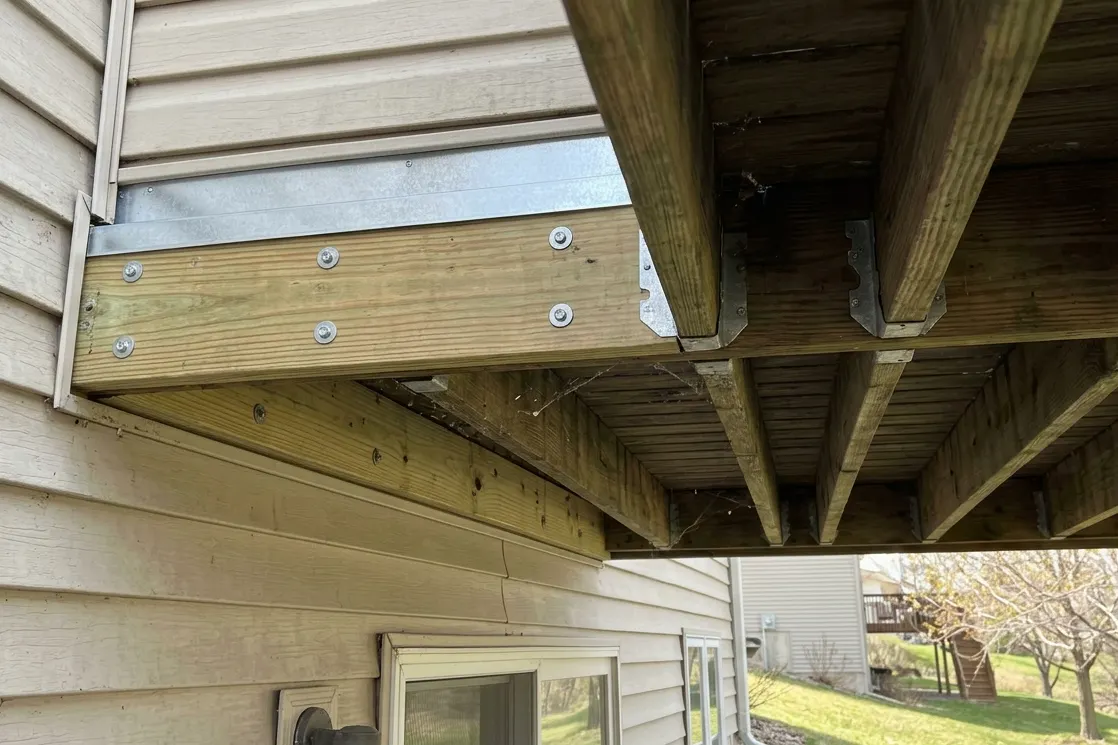
Why the ledger is the weak point on so many decks
A deck ledger is a single board fastened to the rim joist of your house. Every joist on that side hangs from it, so it carries a big share of the deck, the snow piled on it and the people at your next cookout. Unlike posts and beams, it sits tight against the siding, right where rain, snowmelt and splash water collect. If water gets behind it, rot starts in two places at once: the ledger itself and the house framing it is fastened to.
That is why ledger failure is the most common serious problem we find on older decks around the metro. Many decks built in the 1980s and 1990s used nails instead of bolts and skipped flashing altogether. The nails corrode, the wood softens, and a connection that seemed fine for twenty summers can let go under a crowd or a heavy load of wet spring snow. The rest of the deck may look solid, which is exactly what makes this failure so easy to miss.
What a failing ledger looks like from the yard
Start under the deck, near the house, with a flashlight on a dry day. Look at the face of the ledger where the joists meet it, and at the siding just above and below. Healthy wood is even in color and firm when you press a screwdriver tip into it. Rotting wood is dark, stained, soft or crumbly, and the tip sinks in with little pressure. Then step back into the yard and sight along the ledger line to see whether it stays straight.
Flashing is the piece you are most likely to find missing. Done right, a metal or membrane flashing runs up behind the siding and laps over the top of the ledger, so water sheds onto the deck side instead of soaking behind the board. If you see the top of the ledger butted straight against the siding, or a bead of caulk trying to do the job, water has probably been getting in for years.
- Dark streaks or staining running down the siding below the ledger
- A gap opening between the ledger and the house wall
- Nail or bolt heads with heavy rust or bleeding stains
- Joist hangers that are bent, pulled loose or missing nails
- No metal or membrane flashing visible above the ledger
Clues you can find inside the basement or lower level
The other side of the ledger is the rim joist of your house, and you can often check it from inside. In an unfinished basement, find the wall behind the deck and look at the wood sill and rim joist sitting on top of the foundation. Water stains, white mineral crust, mold, damp insulation or soft wood in that band are strong signs that water is getting past the ledger connection. A musty smell in that corner of the basement each spring is worth following up too.
Finished basements make this harder, but the clues are still there. Watch for ceiling stains along the exterior wall under the deck door, bubbling paint on the drywall, or carpet that feels damp near the wall after a thaw. On walkout homes the deck often sits at main floor level above a finished lower level, so a ledger leak shows up as a stain in a family room ceiling. If you spot any of these, call before the next heavy snow lands on the deck.
How a proper ledger attachment is built today
A sound ledger starts with flashing. We remove siding along the ledger line, apply a self-adhered membrane to the house sheathing, and add a formed metal or membrane flashing that laps over the top of the ledger and tucks behind the siding above. Spacers or a drainage gap behind the board can help water dry out instead of sitting. Only then do we fasten the ledger to the rim joist of the house, never to brick veneer, siding or a cantilevered floor.
Fasteners are the second half of the job. We use through-bolts with washers, or structural ledger screws from makers such as FastenMaster or Simpson Strong-Tie, set in the staggered pattern the permit drawings specify. Nails alone do not belong in a ledger. All of the hardware is hot-dip galvanized or stainless and rated for treated lumber, because modern ACQ and CA lumber corrodes the wrong hangers and bolts. Some decks also get lateral load connectors that tie the deck frame to the floor joists inside.
When a ledger problem means staying off the deck
Some findings call for keeping people off the deck until it is shored. A ledger that has pulled away from the house, bolts you can wiggle by hand, or a rim joist that crumbles under a screwdriver all mean the connection may not hold a crowd. The same goes for a deck that has started to sag at the house side after a big snow. Put a chair across the patio door, move the grill and any gatherings to the lawn, and phone us.
- A ledger visibly pulled away from the house at any point
- Joists that shift when you push on them near the house
- Soft or crumbling wood behind or under the ledger
- New cracking sounds when people walk near the door
Repairing or replacing a ledger, and what it typically costs
If the rot stops at the ledger, we shore the deck with temporary beams, remove the old board, flash the wall correctly and install a new ledger with proper fasteners. If the house rim joist is soft, we cut out the damaged section and splice in new framing before the ledger goes back on. Sometimes the cleaner fix is to stop relying on the house entirely and add a beam and footings along that side, so the deck stands on its own.
Ledger board repair and flashing typically runs $1,740 to $6,380 per ledger repair in the Twin Cities. Deck height, ledger length, how much house framing has rotted, the siding type and whether we can work from below all move that number. It is a typical range, not a quote, and the real cost comes after we look at the deck and the wall behind it. Phone (612) 979-0602 if you have found soft wood or a gap at your ledger; we answer 24/7.
Common questions
Can a deck ledger be attached to a brick or stone veneer house?
Not to the veneer itself. Brick and stone veneer is a facing, not a structural wall, and it was never meant to carry a deck. On those homes we either fasten through to solid structure the code allows or, more often, build the deck freestanding with its own beam and footings along the house side. Your city building department reviews the method on the drawings.
Should I worry if my deck ledger is nailed instead of bolted?
It is worth a closer look. Nailed ledgers were common on decks built decades ago, and nails can corrode and work loose over time. That does not mean your deck will fail tomorrow, but the connection lacks the margin a bolted or screwed ledger has. An inspection tells you whether to add fasteners and flashing now or plan for a bigger repair.
How often should I check my deck ledger for rot?
Look at it every spring after the snow melts, since that is when winter water damage shows. A flashlight check underneath and a look at the basement wall behind the deck take only a few minutes. If you are unsure what you are seeing, a deck safety inspection from us puts a carpenter's eyes and a probe on the connection.